Summer Storm Season in Marietta, GA: How to Protect Your Home
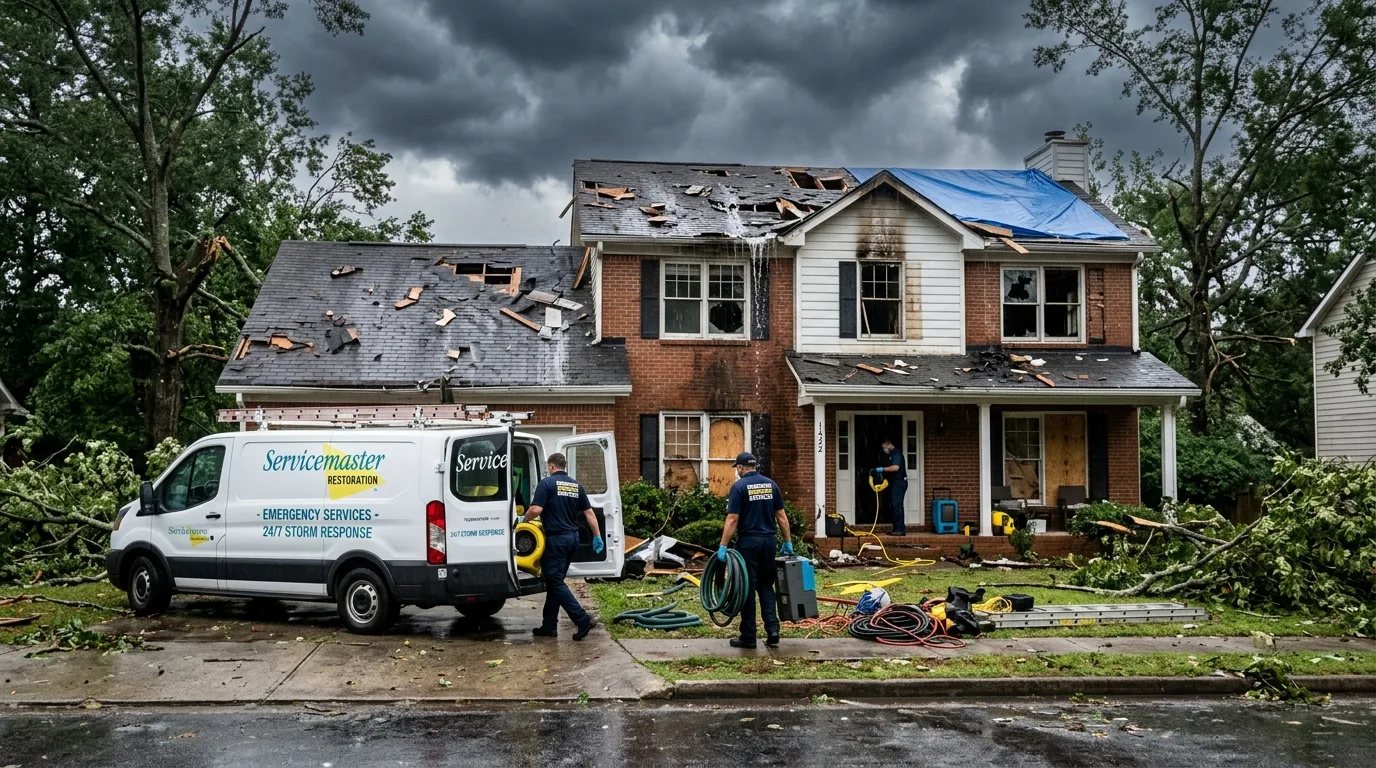
By May, Marietta’s storm season is already underway. By July — the wettest month, averaging 5.4 inches of rainfall — severe thunderstorms capable of producing 2–4 inches of rain per hour are the norm, not the exception. For homeowners throughout Cobb County, summer storm season is the highest-risk period for flash flooding, basement flooding, and the structural water damage that follows. The good news: most storm damage is preventable with the right preparation. This guide covers the specific steps Marietta homeowners should take before, during, and after summer storms to protect their properties.
In this post, we cover the storm conditions that drive flooding in Marietta, property preparation steps that reduce risk, what to do during a storm event, and what to do immediately after flooding occurs.
Storm Damage or Flooding in Your Marietta Home?
We respond 24/7 to storm damage events across Marietta and Cobb County. Call (877) 698-1311.
What Makes Marietta Summer Storms So Damaging
Marietta’s summer storm pattern is driven by its humid subtropical climate and position in the Atlanta metro area’s convective storm corridor. Afternoon heating builds atmospheric instability that generates severe thunderstorms almost daily during June through August. These storms are often highly localized — a cell that drops 3 inches on an East Cobb neighborhood may drop half an inch on a neighborhood two miles away. This localization makes storm damage preparation important for every home, not just those in designated flood zones.
The critical factor that converts heavy rain into flood damage in Marietta is Georgia red clay soil. Clay soil’s low permeability means that at peak rainfall intensity — 2–4 inches per hour — virtually none of the rainfall is absorbed. All of it becomes surface runoff, channeled by terrain and impervious surfaces (roads, driveways, rooftops) toward low points. Homes at the low end of a clay-soil lot or adjacent to a paved surface that channels runoff can receive water from a catchment area far larger than their own lot.
The Chimney Springs and Indian Hills communities, where lots often have topographic variation and mature tree canopy that increases surface runoff, experience concentrated storm flooding at specific low points that recur predictably. Understanding the drainage topology of your lot is the foundation of effective storm preparation in these neighborhoods.
Pre-Storm Preparation: What to Do Now
Clean gutters and extend downspouts. Clogged gutters overflow at the fascia board, depositing water directly against the foundation rather than directing it away. Downspouts that discharge within 2–3 feet of the foundation are another direct source of foundation-adjacent water accumulation. Clean gutters before storm season begins (April is ideal in Marietta) and extend downspout discharge at least 6 feet from the foundation.
Inspect and test your sump pump. Pour water into the sump pit to confirm the pump activates and runs normally. Test the battery backup if installed. Replace a pump more than 10 years old before storm season — sump pump failure during a flood event is the worst possible time to discover the pump doesn’t work. Consider a backup pump if your basement has experienced flooding in prior years.
Clear window wells. Remove leaves and debris that have accumulated in basement window wells. Install covers to prevent direct rainfall accumulation. Check that the drain at the bottom of each well is clear and functional.
Assess exterior grade. Walk around your foundation during a rain event to observe where water accumulates and drains. Any area where water flows toward rather than away from the foundation represents a flooding risk that grade correction or a swale can address.
Inspect the roof and flashing. Roof leaks during summer storms can introduce large volumes of water through compromised flashing at chimneys, skylights, and dormers. A spring roof inspection identifies issues before they become storm-damage claims.
During a Storm: What to Monitor
When a major storm hits, check these areas in order:
Window wells: Check that wells are not filling with water. If a well is filling, the drain is likely blocked — clear it if accessible and safe.
Basement floor drain: Any sign of water backing up through the floor drain during heavy rain indicates municipal sewer backpressure is building. This is the precursor to sewage backup. If you see this, consider shutting off lower-level fixture connections if possible.
Sump pit: Verify the pump is cycling on and the discharge is running. A sump pump running continuously during a heavy event is working correctly. A sump pump that is not running when the pit has water indicates a failure.
Roof during inspection-safe conditions: After storm intensity reduces but before it ends, a visual check of the roof through upper windows can identify obvious damage. Don’t go on the roof during a storm.
Summer Storm Flood Damage in Your Marietta Home?
We respond immediately after storm events — 24/7 emergency flood cleanup across Marietta, East Cobb, West Cobb, and all of Cobb County. Call (877) 698-1311.
After a Storm: Immediate Steps
Document before cleanup. Before removing water or damaged materials, photograph everything — the source of entry, the water level, every affected material and room. This documentation is critical for insurance claims assistance.
Determine water category. If flooding came from outside (storm water), it may contain contaminants from lawn chemicals, automotive residue, and sewage — treat as Category 2 or 3 rather than Category 1. If flooding came from a burst supply line, it’s clean water.
Call for professional water extraction if water entered the home. Surface mopping does not address moisture in structural assemblies. Marietta’s post-storm humidity makes structural drying time-critical — call for professional extraction immediately.
Check for structural damage. Visible bowing in walls, ceiling sags, or cracks that weren’t there before a storm can indicate structural loading from water accumulation. If you observe these signs, consult a structural engineer before performing any work in the affected area.
Frequently Asked Questions
When is Marietta’s worst period for storm flooding?
June through August — particularly July, which averages 5.4 inches of rainfall and the highest frequency of severe thunderstorm events. Spring (March–May) is the second-highest risk period. Winter is lower risk for storm flooding but brings burst pipe risk. Our team is available 24/7 through all seasons.
Does homeowners insurance cover storm flooding in Marietta?
Flooding from storm water entering from outside the home is excluded from standard homeowners policies — separate flood insurance is required. Storm damage to the building from a covered peril (wind, hail, falling tree) is typically covered. See our Georgia homeowners insurance guide.
How much does storm flood damage cleanup cost in Marietta?
Storm flooding typically falls in the $3,000–$10,000 range for moderate residential events, and can exceed $20,000 for significant events with structural damage. See our full water damage cost guide for Marietta.
Get Ready for Marietta's Storm Season — and Get Help If You Need It.
Call Marietta Water Damage Restoration at (877) 698-1311 for emergency storm flood cleanup across Marietta, Kennesaw, Smyrna, and all of Cobb County.
Related: