Why Georgia's Red Clay Soil Makes Water Damage Worse in Marietta
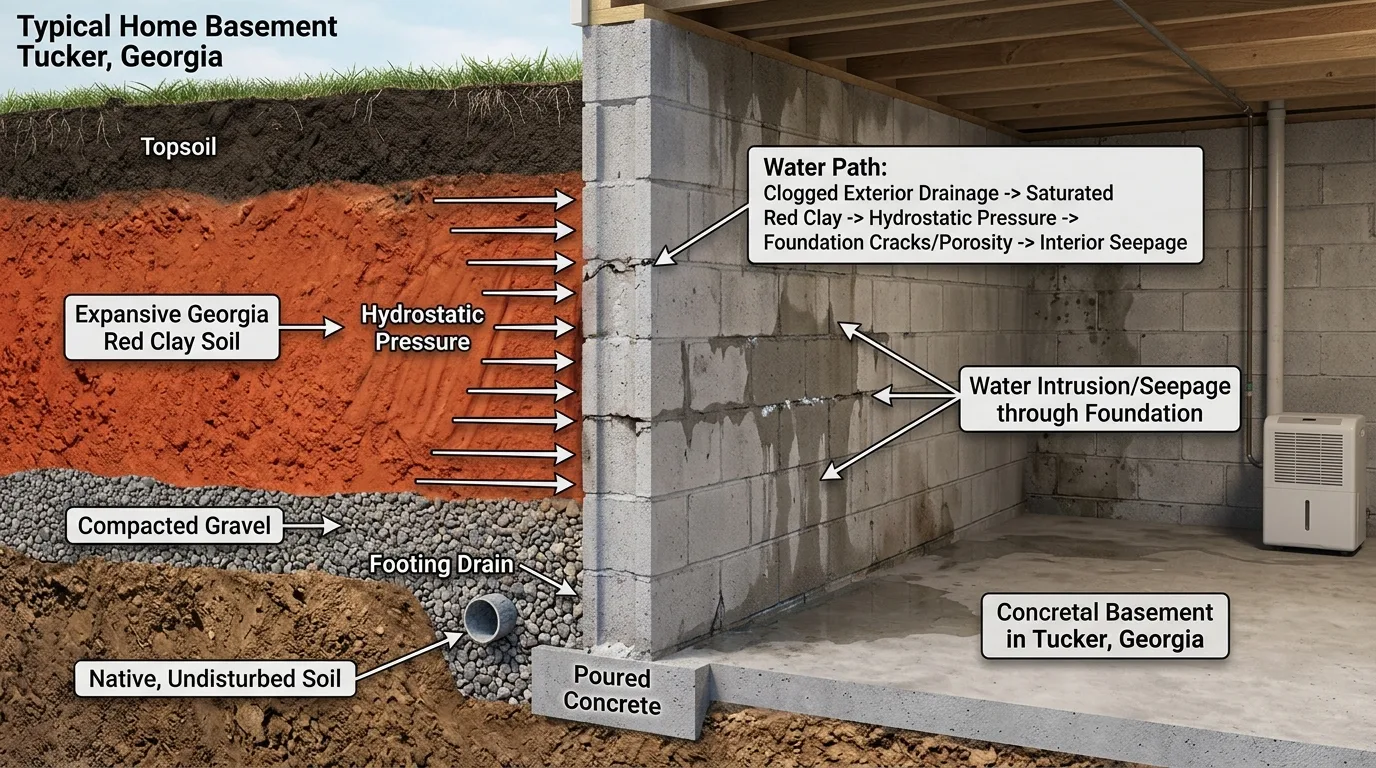
Most homeowners think of red clay as a muddy nuisance. But for anyone who owns property in Marietta, Georgia, red clay soil is a significant factor in how water damage occurs, how severe it becomes, and how difficult it is to permanently prevent. Georgia’s Piedmont region red clay — technically Ultisols, the reddish soil that stains driveways and shoes throughout Cobb County — behaves in ways that directly amplify water damage risk compared to sandier or loamier soil types. In this post, we cover the mechanics of how red clay affects water drainage, foundation moisture, and crawl space conditions in Marietta homes.
In this post, we cover what red clay does when it rains, how it affects foundations and crawl spaces, why it accelerates water damage outcomes, and what Marietta homeowners can do to mitigate the risk.
Water Damage From Foundation Seepage in Marietta?
We know Cobb County's red clay soil and how it drives water damage. Call (877) 698-1311 for a free assessment.
Why Red Clay Soil Behaves Differently Than Other Soil Types
Georgia red clay is classified as a low-permeability, high-shrink-swell soil — meaning it has very poor drainage capacity and undergoes significant volume changes with moisture content. When dry, red clay can become nearly as hard as pavement. When saturated, the same soil becomes dense mud with dramatically reduced bearing capacity — and it expands approximately 20% in volume compared to its dry state.
This expansion-contraction cycle repeats every season in Marietta. The heaviest rainfall runs May through August, saturating the clay and causing it to expand. Late fall and winter bring drier conditions that cause the clay to contract. Each cycle moves the soil slightly, and over years of this repetition, the soil around and under Marietta foundations shifts in ways that standard construction accounts for but that create pathways for moisture to enter.
How Red Clay Creates Foundation Seepage in Cobb County Homes
When heavy rain saturates the clay surrounding a foundation, two things happen simultaneously. First, water that cannot drain downward — because clay prevents it — accumulates at the surface and is channeled horizontally, following the path of least resistance. If your lot has any slope toward the house, or if the grade around your foundation has settled over time, that horizontal water flow moves toward your foundation wall.
Second, the expanding clay exerts hydrostatic pressure against the foundation. Water trapped between the foundation wall and the saturated, expanding clay soil is under pressure — and pressure drives water through the micro-cracks, joint gaps, and block voids in foundation walls that all masonry foundations develop over time. This is why basements in West Cobb and throughout Cobb County flood during heavy rains even when no visible foundation crack exists: water is being forced through pores in the masonry by hydrostatic pressure from the saturated clay outside.
This mechanism is well-documented in Cobb County’s housing stock. The 911 Restoration Marietta team and local restoration contractors consistently cite clay soil as a primary driver of water damage calls following summer thunderstorms — exactly because the combination of 2–4 inches per hour of rainfall on low-permeability clay produces the conditions described above.
Foundation Seepage or Basement Flooding in Marietta?
Red clay soil is the most common driver we see in Cobb County. Call (877) 698-1311 for expert assessment and restoration.
Red Clay and Crawl Space Moisture
Below-grade crawl spaces in Marietta sit directly above red clay soil that maintains elevated moisture content for months after the rainy season ends. Soil moisture vapor — water that exists as vapor within the soil — continuously rises through the soil surface and into the crawl space below the home. Without a proper vapor barrier or full crawl space encapsulation, this vapor enters the structural wood framing, subfloor assembly, and insulation.
Unlike above-grade moisture problems that at least benefit from air circulation, crawl space moisture accumulates in a confined, poorly ventilated space where it stays. Wood framing that maintains moisture content above 19% for extended periods is susceptible to wood rot and provides the humidity and food source that wood-destroying fungi — and eventually mold — require. Homes in the Chestnut Creek neighborhood, where wooded lots shade the ground and slow natural evaporation, show chronically elevated crawl space moisture that tracks directly to the clay soil beneath.
The seasonal expansion-contraction of red clay also affects vapor barriers already installed. As clay swells and then contracts under an older polyethylene vapor barrier, the barrier shifts, folds, and eventually develops tears and gaps. A vapor barrier that was properly installed 10 years ago may have degraded to the point of providing minimal moisture protection — which is why annual crawl space inspections are particularly important for Marietta homes on clay-soil lots. For detailed treatment options, see our crawl space water damage service page.
What Red Clay Means for Water Damage Restoration Outcomes
Red clay soil affects not just how water enters Marietta homes but how difficult water damage restoration is once water is inside. Because clay-saturated soil maintains pressure against the foundation during the entire period that a restoration job is underway, the exterior moisture source is active while the interior drying process is happening. This requires restoration teams to achieve lower indoor moisture targets — because ambient moisture is higher — and to use more industrial dehumidification capacity to overcome the continuous vapor drive from the surrounding soil.
In practical terms, this means structural drying in a Marietta clay-soil environment often takes 1–2 days longer than a comparable job in a market with more permeable soil, and requires more dehumidifier units running simultaneously. This is reflected in the labor rates of $70–$200 per hour and overall job costs of $2,113–$5,000 that characterize mid-range Marietta water damage restoration — the Cobb County clay-soil environment is a genuine cost driver, not simply market pricing.
What Marietta Homeowners Can Do
Manage exterior drainage. The most effective mitigation for red clay water damage risk is ensuring water cannot accumulate against the foundation. This means maintaining positive grade — at least 6 inches of fall in the first 10 feet from the foundation — cleaning gutters and extending downspouts at least 6 feet from the foundation wall, and correcting any landscaping that directs water toward the house.
Inspect and upgrade the crawl space. An annual crawl space inspection identifies vapor barrier integrity, early wood deterioration, and mold before they progress. Full encapsulation is the most effective solution for clay-soil homes with chronic crawl space moisture.
Address foundation cracks promptly. Any crack in a foundation wall — no matter how small — becomes a water intrusion pathway in clay-soil environments with seasonal hydrostatic pressure. Crack injection or hydraulic cement repair addressed early prevents the crack from widening with each expansion-contraction cycle.
For East Cobb and West Cobb homeowners who have experienced recurring water intrusion after heavy rains, the solution typically begins with drainage — not just interior waterproofing. Addressing the exterior clay-soil drainage first provides the most durable long-term result.
Frequently Asked Questions
Is red clay soil the reason my Marietta basement floods every summer?
If flooding correlates with heavy rain events rather than plumbing failures, red clay hydrostatic pressure is likely a contributing factor. The specific entry point — foundation cracks, floor-wall joint, window well — can be identified during a professional assessment.
How does red clay affect mold risk after water damage in Marietta?
The ongoing soil moisture from clay soil means structures in Marietta stay drier more slowly after water events than comparable structures in drier or sandier soil environments. This extended exposure to elevated moisture extends the mold risk window. See our guide on why Marietta homes are at elevated mold risk after water damage.
Can I treat red clay soil around my foundation myself?
Surface grade adjustment and gutter extension are homeowner-appropriate measures. French drain installation, crawl space encapsulation, and foundation crack repair are typically best handled by professionals with the equipment to do them correctly.
Red Clay Soil Driving Water Into Your Marietta Home?
We understand Cobb County's clay soil conditions better than anyone. Call (877) 698-1311 for a free water damage assessment.
Related: