Water Damage Restoration for Marietta's Historic Homes: What You Need to Know
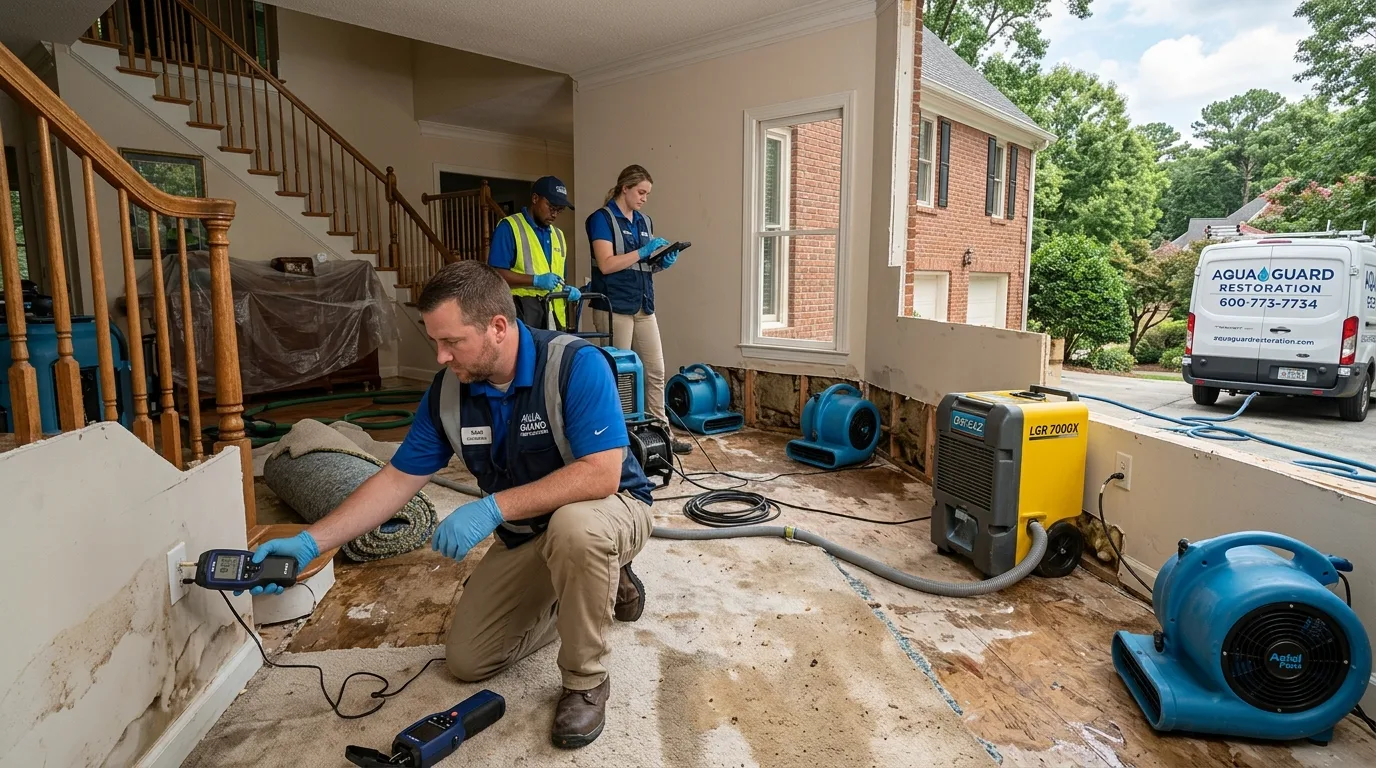
If you own a craftsman bungalow in the Historic Marietta district, a Victorian near Marietta Square, or any pre-1960 home in the neighborhoods that ring Glover Park, water damage restoration requires more consideration than a standard modern home. The materials, construction methods, and infrastructure in historic Marietta homes are fundamentally different from contemporary construction — and those differences directly affect how water damage occurs, how it spreads, and how it should be restored. This guide covers what makes historic home restoration different and how Cobb County homeowners can protect irreplaceable older properties.
In this post, we cover the specific vulnerabilities of historic Marietta homes, the restoration challenges unique to older construction, what to look for when choosing a contractor, and what preservation-conscious restoration involves.
Water Damage in a Historic Marietta Home?
We understand older construction and preservation priorities. Call (877) 698-1311 for a free assessment anywhere in Cobb County.
Why Historic Marietta Homes Are More Vulnerable to Water Damage
The Historic Marietta district encompasses several hundred homes within walking distance of Marietta Square and Glover Park — craftsman bungalows, colonial revivals, Victorian-era homes, and early twentieth-century traditional styles that represent the architectural character that makes the neighborhood distinctive. Many of these homes were built between 1880 and 1940, using construction methods and materials that are no longer standard.
Older plumbing systems. Homes built before 1960 often have original or partially original plumbing — galvanized steel supply lines, cast iron drain lines, and in some cases lead components. Galvanized steel supply lines corrode from the inside over decades, first reducing water pressure and eventually failing with ruptures that can release significant water volume. The same cast iron drain lines that carry sewage away from the home are also deteriorating — and Georgia red clay soil movement from seasonal expansion and contraction accelerates joint separation in older pipe runs beneath the foundation.
Lath and plaster wall construction. Pre-drywall homes were built with wood lath covered in multiple layers of plaster — a wall assembly that absorbs and holds moisture differently than modern drywall. Plaster walls are more durable against minor moisture events but catastrophically susceptible to larger ones: once plaster becomes saturated, it loses structural integrity and can collapse in sections. Standard moisture meters read through drywall reliably but require adjusted interpretation in plaster wall assemblies.
Original wood framing and structural lumber. Old-growth wood framing common in pre-WWII Marietta construction is actually denser and more resistant to water damage than modern dimensional lumber, but decades of minor moisture events may have already created concealed deterioration in floor joists, subfloor assemblies, and structural framing in areas like crawl spaces where visual inspection was never performed.
Inadequate original drainage design. Homes built in the 1920s–1940s were not designed around modern drainage expectations — downspouts discharge directly at the foundation, original grade has often settled over decades to slope toward rather than away from the foundation, and window wells were added as afterthoughts without proper drainage. Marietta’s 53 inches of annual rainfall flowing against a foundation designed before modern drainage standards is a chronic water intrusion challenge.
Restoration Challenges Specific to Historic Marietta Homes
Matching historic materials is difficult. When water damage requires replacing plaster, original wood flooring, or period-appropriate trim, matching the existing materials exactly is often impossible. Old-growth heart pine flooring common in 1920s Marietta craftsman homes cannot be purchased as a commodity product today — replacement sections require salvaged material sourcing. This adds time and cost to historic home restoration that doesn’t apply to modern construction.
Permits and preservation review. Historic Marietta homes within designated historic districts may be subject to review by the Marietta Historic Preservation Commission in addition to standard Cobb County building permits from the Community Development Agency at (770) 528-2060. Exterior changes visible from the street, certain structural repairs, and material substitutions may require Commission approval. We advise on permit requirements and can coordinate with the Commission process as part of full-service restoration.
Concealed conditions. Walls that have never been opened, crawl spaces that have never been inspected, and attic spaces that have accumulated decades of settled insulation all contain conditions that a modern home’s more-accessible assemblies do not. Water damage events in historic homes frequently reveal prior water damage that was patched rather than properly restored — layers of ceiling repairs over old stains, wood framing with historic rot that was encapsulated rather than replaced. Full assessment requires invasive investigation that feels more disruptive in a historic home but is necessary to understand what’s actually there.
Historic Home Water Damage Assessment in Marietta
We work carefully with older construction and can coordinate with historic preservation requirements. Call (877) 698-1311.
Preservation-Conscious Restoration Principles
Save rather than replace when possible. For materials that are salvageable — plaster that can be properly dried and stabilized, original wood flooring that can be dried and refinished, solid wood doors and trim — preservation-conscious restoration prioritizes saving over replacement. This requires more time and skill than standard replacement work, but produces outcomes more consistent with the historic character of the home.
Document conditions before and after. Careful photographic documentation of historic materials before and during restoration allows for accurate reproduction of details when replacement is necessary, and provides the homeowner with a record of the home’s historic fabric that is valuable for future preservation work.
Address the source, not just the damage. Historic homes with repeated water intrusion episodes — staining from past events visible on old plaster, patched areas in wood framing — often have chronic moisture sources that were never properly addressed. Restoring the current damage without finding and fixing the entry point simply restarts the cycle. We include root-cause assessment with every historic home restoration.
Use compatible materials in reconstruction. When new materials must be introduced — replacement drywall in a plaster wall, new wood in a structural assembly — selecting materials compatible with the original construction (similar wood species, similar density, similar vapor permeability) reduces future moisture problems at the material interface.
What to Look for When Choosing a Water Damage Contractor for a Historic Marietta Home
The most important quality is willingness to work carefully rather than efficiently. A contractor who approaches a historic home with the same demolition-first mentality as a modern tract home will generate unnecessarily large material losses. Ask contractors how they approach material assessment in historic properties — whether they distinguish between materials that should be saved and those that must be replaced, and whether they have experience working in plaster-wall construction.
Verify IICRC certification — the same requirement that applies to any water damage contractor. Beyond that, for significant historic home projects, ask whether the contractor has coordinated with the Marietta Historic Preservation Commission before and can do so again if needed.
Frequently Asked Questions
How much does water damage restoration cost in a historic Marietta home?
Historic home restoration typically runs 20–40% higher than comparable modern home restoration due to material sourcing challenges, more careful assessment requirements, and additional permit coordination. A mid-range event that would cost $3,000–$5,000 in a modern home may run $4,000–$7,000 in a historic property. Premium events can exceed $30,000 when extensive plaster and original material replacement is required.
Does homeowners insurance cover water damage in historic Marietta homes?
Standard homeowners insurance covers the same sudden and accidental water damage events in historic homes as in modern ones. The challenge is that replacement cost coverage may not reflect the true cost of replacing historic materials — agreed-value or historic replacement cost endorsements are worth discussing with your agent for homes with significant historic material value.
Do I need a historic preservation review for water damage repairs in Marietta?
Structural repairs within the building interior generally do not require Historic Preservation Commission review. Exterior changes visible from the street — replacing historic windows, changing cladding material, altering roofline — may require review. Interior repairs using period-inappropriate materials in a locally designated historic property may also require consultation. We advise on each situation.
Water Damage in a Historic Marietta Home? We Work Carefully.
Call Marietta Water Damage Restoration at (877) 698-1311. We serve Historic Marietta, Marietta Square, and all of Cobb County with preservation-aware restoration.
Related: